Showing posts with label political. Show all posts

Thursday, 19 May 2011

Tintin on trial


Following the decision of a Brussels court to finally let the case of racism brought against the publishers of owners of Tintin by one Mbuto Mondondo go ahead after several years I decided to give my two cents to the argument. For anyone who doesn't know Tintin in the Congo is easily the most controversial book in the classic children's adventure comic series. It depicts the Congolease in a manner pretty typical of the time: coal black, thick lipped, not so sure how to wear clothes properly, idiotic, gullible, and in need of a sense of direction from the glorious white race. However there were plenty of other comics and books etc that also presented race in a questionable light, and if you search Youtube for controversial black figures in animation from the 1920's-1940's you'll probably come up with a veritable gold mine. There were no real positive black figures in comics until the 60's and 70's and even then they weren't exactly numerous, or fully formed human beings (I'm thinking of Marvel's Luke Cage who was the first black superhero with his own comic, and who at times pandered to blaxplotation cliches rather than explore more complex issues)*(1). Of course Tintin is the most famous example and this is probably why it got picked on, along with the fact that while superhero comics always carry a hint of violence to them, Tintin usually slips under the radar as being a torch bearer for the innocence of youth.

So the question is, should racist views, and uncomfortable events in our past be swept under the carpet and ignored or should we analyse them and try to learn from them? Hilter's Mein Kamp is available to buy and yet we don't worry about churning out a new generation of Hitlers. I used to work with a guy who once told me he felt guilty for the all the crimes white people had committed against black people. How did he elevate this guilt? By giving them free fried chicken, a food they are stereotypically inclined to like. I for one don't feel this 'white man's burden', I wasn't around then, I didn't commit those crimes, so why should I feel guilty?

If we censor something there will be people out there looking for an excuse to justify their own racist viewpoint: ""they did this because this is dangerous, they did this because they are afraid to speak the truth" etc. A classic example of this line of thinking was the relatively recent debate about whether or not Nick Griffin, the head of the BNP, should appear on Question Time. Many people thought he should not be given the opportunity to air his views on television, but I was in agreement that to censor him would just justify his party line, whereas what we saw was him making a fool of himself on national television, and hopefully taking a bit of credibility away from his beliefs.

I don't think the question here should be is TinTin in the Congo racist, it undoubtedly is, and I agree with one commentator who suggests that 'it's of is time' is a poor excuse that crops up time and time again. But should it be banned? No.

There are plenty of graphic novels, and books that can be used in a class room environment to teach tolerance and understanding. Art Speigelman's Maus is the obvious example (because something strange I have noticed when coming into contact with people with ignorant views concerning race is that they all think the Holocaust was a horrific unforgivable thing, yet they can't seem to put two and two together). But I really believe this book could be used as a tool for analysing history and indeed racism itself,. The racism presented in this book is a different kind of monster to the racism we might see today. In colonial times we the Empire took a paternalistic view towards those under our colonial stronghold. We were the fathers, the educators, the moral guides, to these ignorant unruly, yet ultimately well meaning children, and of course they were ever grateful for it (thus the allusions to Tintin being worshiped as a god). There was no unrest, ours was a perfect and nessecery presence (not an intrusion). I also think that we don't have to impose such age limitation on this book, and I think it could be introduced to children as early as 10 years old, in a controlled classroom environment. We should give children more credit, past a certain age they don't have to be sponges for everything they hear outside the classroom, perhaps making them feel that they can be trusted to handle this kind of material, will sharpen their powers of analysis and make them more aware of what racism is (after all children can often say things without being aware of the implications-I remember using gay a lot to suggest bad or rubbish without ever being aware of its link to homosexuality). So long as they are given the context of these images, as one commentator remembers soaking up and accepting this view of black people in the same way that as a child he accepted that America was full of cowboys, Indians, and gangsters from the movies.

According to one source Mondondo said he would be happy if the book was moved to the adults section in bookshops and an explanatory introduction putting the views and representations into context were to be printed in the book, both of these things I thought had already happened. My edition published by Egomont has a small paragraph explaining the influence of colonial attitudes, but perhaps this is not comprehensive enough.

One thing that often gets lost in the arguments surrounding race in this book is also the depiction of big game hunting. In one section of the book Tintin ends up (accidentally, but he had intended to kill at least one) killing a whole group of antelopes.

Also for a brilliant alternative to Tintin in the Congo you could do no better than reading Afrikaan artists Joe Dog and Conrad Botes Bittercomix (which relies heavily on satire to give a view of life in South Africa and references Herge probably on more than one occasion) and even Herge's later Tintin album Tintin in Tibet (approved by the Dali Lama himself) which takes an a slightly more peaceful view of forgien people (although you could argue that although Herge's representation of the Tibetan people is much more positive, it is still fairly one-dimensional).

-------------------------------------------------------------------------------------------------
(*1) For a much more comprehensive look at the depiction of blacks in comics you should probably buy Black Images In The Comics by Fredrik Stomberg

Sunday, 8 May 2011

Steve Bell Royal Wedding Mug

The one piece of royal wedding memorabilia I would have wanted to own would have been this royal wedding mug from Guardian political cartoonist Steve Bell, but unfortunately due to it being a very limited edition print of 50, it is now completely sold out, and there will be no more made.


Featuring his now trademark condom-on-head David Cameron and a very unusual cross breed of pig/arse face/unicorn/George Osbourne. You can watch a brief video with Steve Bell talking about the royal wedding here, braving the rain to get his first glimpse of the royal couple here, and about his mugs here.

Also, if the royal had been anything like this I would have definitely watched it.

In other news if you happen to live in or around Bristol Steve Bell is giving a talk at the Arnolfini as part of the Bristol Festival Ideas on Saturday the 21st of May at 12.30pm. Tickets are £7 (£5 for students, OAPS etc) and are available here.

Monday, 12 July 2010

Blog of the week: World Comics India


Not really a blog this time, but a fantastic website. I may sit comfortably in my flat reading comics like Palestine and Persepolis romanticising the struggles of people in oppressive situations and impoverished areas but World Comics India as part of the World Comics Network are actually seeking to use comics as a driving force for social change and to give those communities who could otherwise not articulate their problems a voice. Started in the early nineties when political cartoonist Sharad Sharma was producing posters for a literacy campaign in Rajasthan, after nine years of organising comic making workshops in the communities across India, they decided to go global and registered as an official organisation. World Comics India is a collective of grassroots activists, students, journalists, cartoonists, and artists, using comics as a communicative tool as well as a means of self expression. The groups main aim is to educate communities in creating their own wallposter comics for use in grassroot local campaigns. They provide training to staff and activists for NGOs (non governmental organisations), and have collaborated with Oxfam, Unicef, Pride, World Vision, Save The Children and many more worth while organisations. They publish anthologies on development as well as training and educational manuals in a variety of languages. Their site is pretty comprehensive but upon further investigation there is a blog too, where you can follow the progress of the project regularly. The blog is here and the site is here.

Friday, 2 July 2010

Comic Classics: Cuba for Beginners-Rius


The book that kick started the For Beginners book series is a humorous cartoon history of Cuba by Mexican cartoonist Rius which is fiercely pro-Cuban and anti-American. Born in 1934 Rius (real name Eduardo del Río) is Mexico's most infamous political cartoonist, with a far-left viewpoint and a zest for activism . His two most famous comics Los Supermachos and Los agachados are humorous critiques of the Mexican government. In Cuba For Beginners Ruis uses a minimum of lines to create simple yet iconic imagery and despite their simplicity a cartoon by Ruis always stands out from the crowd. He comes across a bit like a Latin American Jules Feiffer at times with his playful use of stereotypes, rapid line work that somehow still manages to flow clearly and smoothly, and excellent comic timing and writing skills*(1). He also pastes in a rich history of editorial cartooning, art, advertising, and photographs surrounding the subject of Cuba for our viewing pleasure. Once again the power of comics to entertain and at the same time educate and inform is put to great use.


Ruis's work for the For Beginners book series continues with Lenin and Marx for Beginners.

For another classic of educational comics in this line see the 1976 Introduction to Chile (a cartoon history) by Chris Welch

-------------------------------------------------------------------------------------------------
(*1) Where as nowadays most of the Introducing/For Beginners books are formed by a two person team of writer/researcher and illustrated, Ruis wrote this entire guide himself obviously being passionate and well informed on the subject.

Monday, 21 June 2010

Rude Britannia (BBC FOUR)


In a very similar format to the Comics Britannia programme (probably made by the same people) is this three part series looking at the history of British satire, and out and out rudeness. Part 1 focuses on early rudeness from Hogarth, James Gilroy, Jonathan Swift, and James Stern. Part 2 focuses on Victorian music hall, pornographic pictures, peep shows, crime comics, penny dreadfuls, radio comedy, and crude seaside postcards. Finally part 3 takes in everything from political cartoonists Gerald Scarfe, Martin Rowsen, and Steve Bell, to Spitting Image and alternative comedy, the obscenity trial of Oz magazine, and the PC backlash of publications such as Viz (in fact this is the only point in the programme that overlaps with the Comics Britannia programme, as I swear they just rehash bits of the interview with Viz's creator). This is up on BBC iplayer now (click here) and is a very interesting and informative programme and is well worth checking out. There is currently taking place an exhibition of the same name at Tate Britain in London which is showing much of the same stuff as has been talked about on the programme, and I will be visiting this exhibition when I go to London on Thursday.

Wednesday, 21 April 2010

Comic classics: Barefoot Gen-Keiji Nakazawa


If you have certain prejudices towards manga like I used to have this book should turn that all around. OK so a lot of manga is kiddie-fare dominated with big eyes and generic cutesy or ultra violent sleekness, and they do have an uncomfortable fixation with prepubescent girls and giant penis tentacles, but scratch under the surface and you'll find some works that manage to pull off subtlety and moments of almost cinematic brilliance. Barefoot Gen the majority of the times isn't one of those manga, but it still works. It is precisely the juxtaposition of Laurel and Hardyesque slapstick violence and general over the top gestures against the absolute senseless horror that is going on that makes this graphic novel so effecting. In fact I can say this is the only graphic novel that has caused quite a profound emotional response from me. The story is the autobiographical tale of the artists survival of the Hiroshima bombing, the events leading up to it, and the events that followed. Like most mangas this book was serialised into a multitude of volumes (I think ten in total) but it is the first volume concerning events leading up to, just after, and during the bombing which I am looking at here. The start of the book is mostly concerned with Keiji's families struggles to have enough food to survive, a struggle which is constantly made worse by their fellow Japanese. The reason for their families ill treatment is that their father is a pacifist and outspoken in his opposition to the war, which means that the family are marked as traitors and used as scapegoats by the local police force and opportunistic neighbours. The families eldest son goes off to join the navy to distance himself from his 'traitor' father but soon realises firsthand the madness and the base hypocrisies of war, and especially of the behaviour of those in roles of higher command. Throughout the book it is Keiji and his younger brothers good will love for their family and charitable nature (even though they themselves are so often without food) that adds a real warmth and humanity to this unique and compelling story. All of this makes the impact of the books ending all the more intense. After the bombing Keiji comments that the victims 'look like monsters' and is this exactly how they look. With skin dripping from their bodies and hollowed out eyes, they do look like something from early EC horror comics, thus cementing home the unbelievability and horror of this real life event. Keiji Nakazawa wrote this book as a strong and outspoken anti-war, and anti-nuclear weapon statement and in 1976 a group of Japanese and non-Japanese people formed Project Gen in order to translate his work around the world and spread its message. This book remains as powerful and relevant today as it was when it was first published.

For a great little article about how to get over your Mangaphobia click here.

Saturday, 10 April 2010

Review: A Child in Palestine, The Cartoons of Naji-al-Ali


A Child in Palestine is toilet reading for the politically conscience. Not to trivialise the book or it's subject, but its shape and size and well pieced together chapters make it ideal toilet reading. Naji-al-Ali was a Palestinian political cartoonist who was shot in the head outside the London offices of the Kuwait newspaper he was working for in 1987 (after he was expelled for good from Lebanon). Born in the Galilee village of al-Shajara irn either 1936 0r 1937 and was expelled from the country (along with hundreds of thousands of other Palestinians) in the 1948 war that created the state of Israel. His family eventually settled down in a refugee camp in Southern Lebanon. Being no stranger to the refugee experience it comes as no surprise that he was most famous for drawing the figure of the Palestinian refugee child . This figure came to represent a silent but defiant witness of the atrocities committed against the Palestinian people by the Jews (as well as the hypocrisy and vested interests of the Palestinian government). In the passionate, well-informed, and fascinating text between the images, al-Ali's work is placed in a broader cultural, historical, social context that gives you a rich lesson in Palestinian politics and resistance, but also shows how al-Ali himself was an important part of the fabric of Palestine. Hanthala the refugee became a symbol for the Palestinian people that would sprang up everywhere (often in graffiti) and al-Ali is often spoken about with the same reverence Alsatians reserve for their best poets. In the book we are given excellent reasoning behind Hanthala who is never allowed to grow old because to do so would normalize the plight of the refugees, and who is made to look ugly, like the child no one would want, which helped the Palestinians who felt poor and unwanted, identify with him all the more.

The drawings themselves are simple and bold, but make use of a scratchy and unrestrained cross-hatching technique that you don't often see in the likes of Western editorial cartooning. There is a real sense of place in al-Ali's work and he isn't afraid to make his cartoons morbid and bleak as opposed to always chasing the punchline, although when a punchline is present it is often put in place to show the absurdity of the situation. As this is editorial cartooning, al-Ali deals unchanging stereotypes, his Arab leaders look like fat shapeless blogs while his Jew's come across as maniacal gnomes. Although his constant portrayal of the heroic, the tragic, Palestinian common man could perhaps be construed as being a bit reductive at times. To show humour in the face of unequal odds is a great strength but it is clear from this book al-Ali did not want to take the plight of the Palestinians lying down and as the book progresses Hanthala becomes a more active figure, raising his fist defiantly, throwing stones, sounding bugles, and raising flags.
However as al-Ali was never closely tied with any of the political factions in Palestine (although there were rumours as to where his sympathies laid) he could perhaps have been accused of substituting action for mere words and pictures. Although in a country where mere words and pictures can lead to imprisonment, expulsion and death al-Ali is a brave torch for the silenced minority.


(I am aware of my slight bias towards the subject of this book due mainly to the facts gathered by Joe Saccos Palestine, and perhaps I shouldn't jump the gun in my judgements of the Palestine/Israel conflict because the facts I have gathered so far are of course ever so slightly objective and I don't know enough about the situation to make a valid assessment of it, however that doesn't change the fact that this book is an important piece of history and worthy of holding up against the current situation)

Friday, 2 April 2010

10 childrens comics that adults can enjoy


With brilliant characters often seen to outwit their adult counterparts, as well as possessing very mature neuroses that we will all recognise, the children's comic is often ripe with satire and political ideas, and should not be overlooked:

The Moomins

The Japanese produced animated series was a nice mix of cutesy idealism and freakishly terrifying segments which were genuinely unsettling to me as a child (Moomin turning into a hairless monkey, and the eiree pulsating white creatures spring to mind). The original syndicated newspaper strip however as well as being charming and dare I say it 'quaint' can easily be enjoyed as an adult for its satiric elements. Through the adventures of the Moomin family Tove Jansson was able to poke fun at upper middle class pretensions, the world of modern art, and much more besides.

Miss Peach-Mel Lazarus

A lesser known gem of teacher pupil comics by Mel Lazarus about a class of over inquisitive and boisterous who run rings around the adults they encounter.


Pogo-Walt Kelly

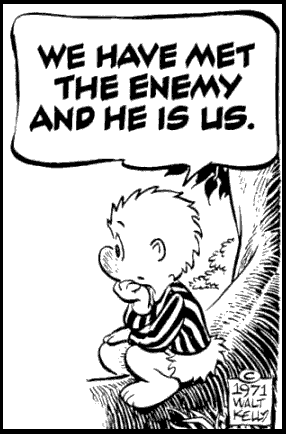
Long before the G8 summit Walt Kelly's Pogo made us aware of the environmental crisis with the classic line 'we have met the enemy and he is us'. Walt Kelly managed to make a 'funny animals' comic strip about swamp land critters into a witty and lyrical social and political satire that like George Herrimen's Krazy Kat developed a language all of its own which was inspired by Kelly's American-Irish upbringing (he has often been compared to James Joyce when it comes to his use of language). Kelly himself was considered a progressive independent in terms of his politics and was said to be against the extreme Left, the extreme right, and the extreme Middle. He was also considered enough of a threat that the FBI kept his phone tapped and at one point the U.S Government was in contact with a journalist who claimed that the eccentric jargon Kelly invented for his Pogo strips was actually a secret Russian code (this was of course during the era of the McCarthy communist witch hunts). Not bad for a mere 'funny animals' cartoonist!


Calvin and Hobbes-Bill Watterson

The classic newspaper strip by American Bill Waterson featured the over imaginative high jinx's of a young boy called Calvin and his stuffed toy tiger Hobbes who he sees as a living breathing life sized tiger. Inspired by the likes of Pogo, Krazy Kat, and Peanuts, the strip lends it's six year old protagonist a highly advanced vocabulary, mixed with a child's natural curiosity. Like The Moomins Calvin and Hobbes also pokes fun at the art world, through Calvin's unusual melted snowmen sculptures, pictures of dinosaurs in rocket ships, and pavement art ('suburban postmodernism'). Although being careful never to reference real people or events Watterson lampooned public decadence and apathy, commercialism, the pandering nature of the mass media, the flaws of public opinion polls, education, environmentalism, and much more besides. Witty and with a playful and colourful drawing style the eventual demise of Calvin and Hobbes left a gaping hole in the newspaper strip which would only later come to be filled by Richard Thompson's Cul De Sac.

Cul De Sac-Richard Thompson

This modern day newspaper strip is obviously good enough to warrant a praiseworthy introduction by the creator of Calvin and Hobbes Bill Waterson and follows on by putting sometimes adult voices into the mouths of inquisitive children who are as bemused at their parents odd behaviour as they are at theirs. At times wonderfully colourful with a superb use of watercolours and scratchy and erratic line work Cul De Sac is one of those wonderful rarities, a comic that will make you laugh out loud.


Peanuts-Charles Schulz

Charlie Brown is probably the most depressed figure in children's comics ever and perhaps sewed the seeds for neurotic confessional indie comic artists everywhere even more so than Justin Green and Robert Crumb. Charlie Brown was the ultimate anti-hero, his life a regular Kafkaesque roll call of disappointments. He couldn't fly a kite, kick a ball, or win a game of baseball but we loved him all the same. Of course this Kafka reference could be construed as being a little bit pretentious, but I wouldn't be the first to make it, just look at this satirical strip from R Sikoryak:

As for the strip itself Charles Schulz could read the little idiosyncrasies of children fantastically as well as giving them an almost pure intelligence and inquisitiveness. He mixed social and political satire brilliantly launching attacks on the Vietnam war, the psychiatrist gags and the interaction between Lucy and Shroader, and seemed to ignore gender equalities completely, the singular black character fitting in amongst them without question, and females playing on the baseball team. Not to mention that some of the animated films were pretty great too.

Krazy Kat-George Herrimen

The premise behind this classic 1910's strip is quite simple. Mouse despises cat, cat loves mouse. Mouse throws brick at cats head, cat sees it as a sign of mouses love. In the meantime the local police officer, a dog, tries to prevent mouse from throwing brick because dog loves cat. Repeat with variations. Of course the fact that the cat's gender was never clearly specified gave this strip an almost radical and ambiguous streak (especially considering the time it was created). Herrimen himself lived with a certain amount of ambiguity in his lifetime, being born to two light skinned ('mulatto') parents he often passed himself off as white, or of Greek descent, and he was even recorded as being Caucasian on his death certificate.
Krazy Kat is one of those few comic artists who have been embraced by the world of fine art who see the seeds of surrealism in his work and the similarities between some of his ever changing backgrounds and the work of someone like Miro are quite striking (it was also said that Picasso was a fan).

Little Nemo In Slumberland-Windsor McCay

Created by Windsor McCay (arguably the creator of the first animated film) the artwork for this one of the pioneering strips of early comic strips makes fantastic use of Art Deco landscapes, optical illusions, immense feats of warped perspective, lashings of colour, and an inativive spreading of images across several panels, as well as some spectacular larger panels.
The only criticism I would have of this classic strip, is that being so early, the use of narrative text at the bottom of the panel below the speech balloons would often confuse the reading order and break up the strips continuity.

Malfada-Quino

Similar in appearance to another famous cartoon little girl called Nancy, Argentinian cartoonist Quino's creation Malfada is a young girl with strong political opinions and a desire for world peace and a love of humanity. This is a strip is considered by its creator to be socio-political with strong family values thus explaining the stronger presence of adult characters in it as opposed to Peanuts which featured none (except for the omnipresent yet invisible teacher).

The Kin-der-Kids-Lyonel Feininger

Another pioneer in comics early history and a deliberate step away from the violence of other kids strips like Happy Hooligan etc. Serialised in The Chicago Sunday Tribune between the years 1906 and 1907 The Kin-der-kids is a beautifully coloured, painted, detailed, whimsical strip similar in vein to Little Nemo in which a group of children travel the world in an antique bath tub and use their various 'skills' (bookishness, huge appetite, strenght etc) to help them out in their adventures. Visually stunning and sparing and effective in its use of dialogue, some of the adult characters possessing strange almost malnourished faces.


Thursday, 1 April 2010

Review: Funny Girls, Cartooning for equality


Funny girls is a great little companion book to an exhibition of the same name curated by Diane Atkinson. Published by Penguin this set me back a mere 1p (minus post and packaging) and I can safely say it was worth it. The book is a short yet sweet (and by no means complete) history of the women's movement and the struggle for equality told with great wit and simplicity through the medium of cartoons. It encompasses some classic moments and members of British cartooning from Punch magazine and beyond such as Giles, Ronald Searle, and Osbert Lancaster. There are anti-suffragette cartoons playing on irrational fears and stereotypes (such as the breakdown of the family unit and the 'ugly feminist') and of course there is the iconic moment Emiline Pankhurst slapped a police officer. It's the sympathetic cartoons by the more switched on members of the male cartooning establishment that stand out for me. Some of these cartoonists even go as far as to use a female pseudonym such as Vicky or take on the maiden name of the cartoonists mother . These cartoons usually do a great job of making the men in question, and the male institutions, look pompous, absurd, obsolete, and ripe with double standards, therefore removing part of the power they have over women, at least momentarily.
Of course cartooning isn't the final solution and the question of whether it can change peoples minds is tackled by each artist in the book which is a nice way of making things flow. However when the female cartoonists started to get hold of the pen they did so with bite and they did so with style. Although some of them took to mimicking the great gag cartoonists of The New Yorker (albeit with much better, more modern, more relevant punchlines) some of these artists display a sparing use of line that adds to the humour and the impact of the story. Despite criticism that cartoons are stereotypes and are not an imaginative art form I feel that when the 'less is more' approach is properly utilised, we are left to fill in the gaps of the picture and form an appropriate emotional and critical response. One such artist in this book who manages this pretty well is Jacky Fleming who sums up the mood of an entire picture with limited lines. These gappy, sparse, and 'erratic' lines are similar in some ways to the Roberta Gregory's infamous Bitchy Bitch comics which has a constant trace of anger throughout. It's easy to see that these artists have a lot to be angry about but they don't let themselves be entirely defined by this anger and tend to use humour as a weapon too. This book has thankfully filled in a slight gap in my knowledge to do with UK female comic artists as before this the only one I really knew well was the brilliant Posy Simmonds (who of course is well represented in this book). It also is a great resource book giving you names of artists of considerable influence to go explore. As someone who likes to devour his social history through cartoons and as a feminist this book is an absolute essential addition to my collection. Covers everything from The Great Double Standard to the juggling of home life and work life. A great find!

(click on pictures to enlarge and read captions)

Tuesday, 9 February 2010

Comics and controversy

Following on from a comment I made in the post above, I've decided to compile a short list of cases of censorship, criminal trials, and even death, all related to the world of comics. The majority of these cases have to do with the underground comics of the sixties, a time where head shops were constantly raided for such material, and the export of underground comics to the UK was strictly monitored:

(1 The Oz School Girls Issue

I remember watching an episode of The Secret Millionaire in which the presumably well educated millionaire confesses to the camera about his expulsion from college, not on the grounds of smoking drugs or being violent towards a member of staff, but simply for reading and being in possession of what the college obviously considered dangerous and radical material, that is Oz magazine. Oz was a counter-cultural magazine started in Sydney Australia in 1963 which moved its based of operations to London in 1967. It was the famed 'School Kids Issue' that became the centre of one of the longest obscenity trials in the UK. The issue was a response to the criticism that Oz had lost touch with the kids, so the editors of the magazine invited a whole host of secondary school children (mostly all from public schools) to edit an issue of Oz. The image/s in question that caused the Obscene Publications Squad to clamp down on Oz, was an act of simple schoolboy humour produced by a 15 year old school boy: the pasting of Rupert the bear's head, onto the body of a character of one of Crumbs obscene cartoons, to give everyone's favourite British institution of childhood innocence, a sexual edge. The trial was pretty well publicised and defence witnesses included DJ John Peel, artist and drugs activist Caroline Coon, and academic Edward De Bono . John and Yoko even became involved forming the Elastic Oz Band and writing a song 'God Save Oz' (later renamed 'God Save Us' to minimise confusion with the US listeners) to raise publicity and funds. The 'Oz three' (as they came to be known) famously turned up to the trail wearing rented schoolgirl costumes and wigs. The result of the trial was that the attempted charge of 'conspiracy to corrupt public morals' failed to stick, however, this didn't stop them from being charged for two lesser offences, and being sentenced to imprisonment, the final nail in the coffin being the police shaving their heads upon arrival at the prison. A copy of the School Kids issue currently goes for between £80-£180 on ebay!


(2 The Trial of Nasty Tales

Another UK obscenity trial, again sparked by the reprinting of a Crumb comic, was sparked when an eight year old boy managed to buy a copy of the adult comic Nasty Tales at a newsagent, and his mother complained to the police (it was later revealed that his mum put him up to it). The police proceeded to raid the offices of Nasty Tales and made off with several boxes worth of the comic. The charge brought against the editors was that of 'possessing an obscene publication for gain' although as one of the defences witnesses (none other than Germaine Greer!) boldly stated: 'Among comic strips and comic books this is rather better than most and a good deal less insidious in its effect on public taste than Superman'. A similarity between this and the Oz obscenity case was that the prosecution seemed to jump on the representation of (and therefore encouragement of) 'perverse' sexual behaviour such as sadism, and (shock horror!) homosexuality. The verdict was an outstanding 10 to 2 of not guilty and Nasty Tales celebrated by printing a comic book version of the trial transcripts drawn by Dave Gibbons, Edward Barker, Chris Welch, George Snow, and Martin Sudden (a comic which you can still see lurking around on Ebay now again, and it's quite cheap at that!)

(3 The Pirate and the Mouse

In 1971 a group of underground cartoonists lead by Danny O'Neil were foolish enough to take on Walt Disney when they printed two issues of an underground comic called 'Air Pirate Funnies' in which they had characters that strongly resembled Disney characters (O'Neil had claimed that changing the names would dilute the satire) partaking in sexual activities and drug taking. O'Neil saw Disney as a symbol of conformist hypocrisy in America and therefore as being ripe for satire. This of course is not a unique case of satirising Disney see also: Will Elder's 'Mickey Rodent' from MAD magazine, Wally Wood's 'The Disneyland Memorial Orgy' spread from The Realist magazine, and even the Swedes were in on it at some point with Charlie Christensen's Arne Anke(*1). Apparently O'Neil was so keen to be sued by Disney that he had copies of his comic smuggled into a board meeting at the company, by a board members son. By the end of 1971 O'Neil got his wish and Disney filed a lawsuit against him and the other members of the Air Pirates for copyright infringement, trademark infringement, and unfair competition. The first impression was that they were going to loose, and O'Neil urged his fellow Air Pirates to settle with Disney and let him carry on the case defending himself. During this time the remaining members of the Air Pirates went against a temporary restraining order and published more material intended for the third Air Pirates comic, in a comic called The Tortoise and The Hare. 10,000 copies of this comic and Disney won a preliminary hearing of $200,000 and another restraining order, which O'Neil continued to defy by drawing more Disney characters. Other underground comic artists also began selling original artwork (mainly of Disney characters) in order to raise money for O'Neil's defence. The case dragged on for several years and finally in 1978 O'Neil lost the case (although they weren't able to pin trademark infringement on him) and in 1979 the court refused to hear an appeal. However it wasn't over for O'Neil yet, in mid 1979 he formed a secret artist organisation called The MLF (Mouse Liberation Front) holding an art show in new york and creating another four page Disney story, which with the help of sympathetic Disney employees he delivered in person to the Disney studios, where he posed at an animation table drawing Mickey Mouse, and apparently smoked a joint in the office of the late Walt Disney. Finally weighing up the massive legal fees and loss in damages, Disney finally agreed to drop the charges if O'Neil promised to no longer draw Disney characters. Opinions on what good this case actually did for the comics business and freedom of speech/the press are divided, and some people believe O'Neil set satire back 20 years.

For more details about this case and to see some original Air Pirates art, you can buy Bob Levin's book on the subject, published by Fantagraphics books, entitled 'The Pirate and the Mouse'

(4 Hector Oesterheld 'disappears'

Argentinean journalist and writer of graphic novels and comics goes missing in 1976 (presumed dead) and a year later his four daughters and their husbands are arrested and never seen again. It is widely believed that the reason for his disappearance is linked to the publication of a biography of Che Guevara published a year after his death and removed from circulation, with the original artwork destroyed by the Argentine government. Now I'm not exactly pro Che's actions and think the prevalence of Che's face in popular culture today is a bit odd (I love to quote Mark Corrigan from Peep Show at this point, where he calls the phenomenon 'the ironic verification of tyrants') but I think this is an interesting and extreme example of censorship and comics. Osterheld's work had at this point become increasingly political, (although sometimes disguised as science fiction) and he was also (along with his daughters) believed to be part of a leftist guerrilla group called Montoneros. Whether or not this political activity had anything to do with his disappearance remains to be seen, to me it seems a bit far fetched that he would be kidnapped and killed on the basis of a comic (Alberto Breccia the artist behind the biography was not punished) but when an Italian journalist asked about his disappearance in 1979 he was met with the reply: 'We did away with him because he wrote the most beautiful story of Che Guevara ever done'.

(5 Busted Jesus Comix

Another American obscenity trail and the first recorded trail to land a cartoonist with a criminal conviction in America. In 1990 teenage school janitor Mike Diana began producing issues of his own adult comic book Boiled Angel using the school's photocopying machines. In 1991 while investigating a Florida murder case, a police officer came across a copy of Boiled Angel and desperate for clues, phoned Diana to inform him he was a suspect, and requested a blood sample. The real killer was soon apprehended and Diana was not pursued. However the police officer in question collected additional copies of Boiled Angel and sent them to the State Attorney's Office where they went on file, and two years later the Assistant State Attorney came across the comics and sent Diana a certified letter telling him that he was being charged for three counts of obscenity under the Florida Statute 847.011-that is for publishing, distributing. and advertising the material. Diana was found guilty on all three counts, and was sentenced to a three-year probation, during which time his residence was subject to inspection to determine if he was in possession of or was creating obscene material. He was to avoid all contact with children under 18, undergo psychological testing, enrol in a journalistic ethics course, pay a $3,000 fine, and perform 1,248 hours of community service. He was also ordered to cease drawing for personal use, and his place of residence was to be open to inspection by the police, without warning or warrant, at any time, for illustrations violating this ruling. He was not sentenced to any jail time, but spent four days in jail between the dates of the verdict and the sentencing. To fulfill the requirement of undergoing a psychiatric evaluation, Diana was informed that the doctor whom he would see charged $100 an hour, which he would have to pay for himself, and that his evaluation would take two hours. After the evaluation, Diana was informed the session would cost $1,200 because the doctor claimed to have spent 10 hours reading Boiled Angel in preparation. Out of funds, Diana was unable to pay, and the doctor refused to give her evaluation to the court, effectively making him in violation of his probation. Diana was eventually allowed to move to New York to serve the remainder of his sentence and his legal ordeal inspired a 2005 off-Broadway play called Busted Jesus Comix. Despite all this, the cynic in me can't help thinking that the legal proceedings and the eventual conviction gave Diana a lot more publicity and acclaim than if it never happened, because upon looking at extracts of Boiled Angel, aside from the nice use of colour in parts, I am reminded a bit too much of the sex blood and shit shock tactics of Vice magazine's resident cartoonist Johnny Ryan (whose only work of merit in my opinion is Prison Pit Volume 1-which yes, is a blood and gore fest, but done in a manga style similar to Tokyo Zombie, which makes it acceptable)(*2) , and perhaps some of the gorier aspects of Ivan Brunetti.


(6 The Infamous Dr Wertham

No list like this would be complete without mentioning Dr Wertham's notorious tirade against the comics, in particular the crime and horror comics of EC, the summary of his ideas (comics as the cause of juvenile delinquency) can be found in his famous book 'The Seduction of The Innocent', which even if you don't agree with it, still makes for a fascinating read. Modern day critics like Bart Beaty have returned to Wertham to suggest that he wasn't as right wing as his most famous work suggested. He was actually anti-censorship, and did a lot of work on the psychological effects of racial segregation in school children, and was a key speaker for the defense in the famous Brown vs Board of education case to end segregated schools in America. In fact the main misunderstanding in the whole Wertham affair is that he wanted to burn comics and ban them all together, he just wished for a system whereby comics were classified as having adult material and therefore could not be bought by children. Whatever you think of him however, without Wertham and the introduction of the Comics Code (which he didn't agree with anyway) things might not have shaped out in quite the same way for comics as we know them today, the underground comics being a direct response to the kind of moral panic Wertham set in motion.

(7 Metro banned

In April 1008 Egypt's first Graphic novel 'Metro' by Magdy L Shafe was banned and all copies seized after the Egyptian courts ruled the author and the books publisher guilty of printing and distributing a publication infringing public decency, and handed down a LE 5,000 fine against both of them. The obscene content in question was the limited sexual content of the book which the author and publisher had tried to safeguard against by putting 'for adults only' stickers on the books. Arab Network for Human Rights Information director Gamal Eid said that defence lawyers submitted to the courts images published in daily newspaper Rose El-Youssef which were "more lewd" than the graphics in "Metro" that the court objected to.

(8 The Anti-Cartoon Legislation and beyond

In 1897 the advancement of printing creates a powerful surge of political cartoons, in response to this politicians in America create an anti-cartoon legislation to regulate political cartoons (the last anti-cartoon legislation is put in place in 1913). In 1903 the regulation of cartoons comes to a head when Walter McDougall challenges Pennsylvania's law forbidding the depiction of political figures of animals. His drawings of Governor Pennypacker, as a tree, a beer, mug, and a variety of tubers leads to the law's repeal.

(9 Those Danish cartoons

There's almost an air of 'the Scottish Play' about me posting about this, but I am of course talking about the twelve editorial cartoons published in a Danish newspaper back in 2005 under the heading 'The face of Muhammad' the most famous of which was Kurt Westergaard's depiction of Muhammad as a man with a bomb in his turban. The details are too extensive to go into in any great detail here, but the backlash from the Muslim community was enormous, with more than 100 people dead in protests around the world, and the burning of Danish flags, and indeed Danish embassies in Syria, Lebanon, and Iran. There was also a recent attempt on Kurt Westergaard's life. For more information on this, wikipedia have a pretty extensive account of the event (and if you type Danish cartoons into google this is the first thing that will come up) and The Comics Reporter has a regularly updated news item which follows critical responses. There is also a critical book on the controversy surrounding the cartoons called The Cartoons That Shook The World (by Jytte Klausen), which I will be taking out from my library very soon.

(10 The Beano and Ideology

There are numerous creative rights cases in the world of comics, perhaps the most famous of which was the Siegel and Shuster case for the rights to their creation of Superman(*3), but I thought I'd include a homegrown favourite here instead. Inc 1980 Leo Baxendale (the creator of beloved comic strips from our youth such as Minnie the Minx, The Bash Street Kids, and Little Plum) started a seven year legal battle with DC Thompson over the rights of his characters, eventually settling out of court. Baxendale wrote a book on the subject called 'On Comedy: The Beano and Ideology', and now runs his own publishing company (Reaper Books) and continues to self-publish his comics.

For more information, and a pretty good timeline of censorship and comics, go to
The Comics Legal Defence Fund

..................................................................................................................................................................
(*1) Arne Anka was a Donald Duck satire that when the artist was threatened with legal action, he responsed by drawing a story where the duck had plastic sugery to replace his rounded beak with a pointed one, thus erasing the resembelance.
(*2) I'm not against blood and gore in comics, far from it, I just think there's a certain way of doing it that's trying too hard to shock us (e.g. the whole severed head doing something sexual) and as a result falls a bit flat
(*3) Another famous case of property rights in the world of comics was when Crumb had to pay out thousands of dollars when it was decided that 'Keep on truckin'' was an image in the public demain, and therefore did not belong to him.