


(number 1&2 tourist destinations in Toronto: The Beguiling Comic Shops and Honest Ed's, weird discount store where a lot of Vice Magazine readers probably buy their clothes)
I fully intended to post this a lot sooner after the event but between preparing for, moving to, and settling in at Dundee to start my Mlitt in Comic Studies I haven’t yet found the time. So hopefully what I have written will still have some impact and not be totally redundant, especially after the brilliant analysis and reflection provided by a number of the other conference delegates. I will try my best to offer my own take on things, as usual any attempts to be brief and succinct have gone straight out the window.


First and foremost, the subheading of this years conference ‘Navigating the margins’ was extremely appropriate given the wide range of boundary pushing artists that were on show. These artists and writers did not let themselves be limited to a traditional and stilted definition of what comics should be, for them the rules were only made to be broken, and they were definitely colouring way outside the margins!(*1) I’m not sure how the amount of lesser known artists compared this year to last years conference, but personally discovering a whole body of new and exciting work was one of the best things about this conference for me.
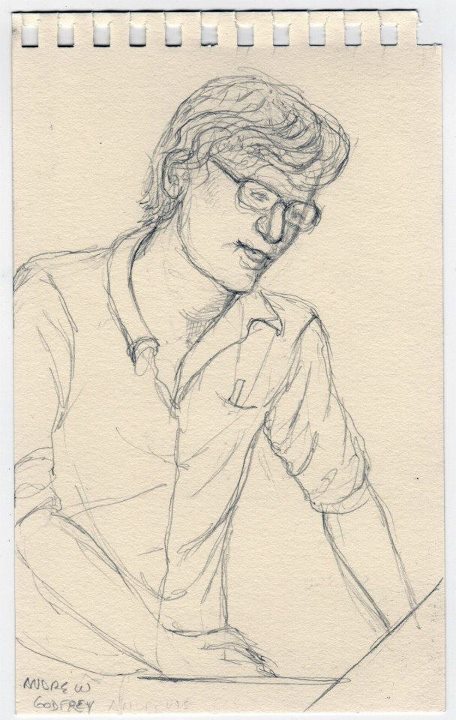
The bar was set pretty high right from the opening reception when we were treated to a screening of the short documentary The Paper Mirror directed by Charissa King-O’Brien. The film follows painter Riva Lehrer (who does fantastic portraits of people in the disability community amongst other things) as she works on a large scale portrait of cartoonist and graphic novelist Alison Bechdel (Dykes to watch out for, Fun Home, Are you my mother?). To a more casual observer it might seem like a documentary about making a painting might seem as dull as (forgive me) watching paint dry, but the film is handled in an extremely sensitive, interesting, and at times quite amusing way. There is a real rapport between Riva and Bechdel and the fact that they are both going in similar directions in their art at the time of filming (wanting to break away (in Riva’s case momentarily) from what they are both known best for) raises some very interesting questions and helps us to examine both artists motives for creating. As someone who enjoys reading comics about the process of making comics (Yoshihiro Tatsumi‘s A Drifting Life and Eddie Campbell’s Alec are particular favourites of mine) to see the amount of detail, hard work, and innovation that goes into Riva’s work was pretty awe-inspiring. In the Q+A Riva also revealed that she goes through a three year interview process in order to get to know her portrait subjects, which shows real commitment! Riva was also one of the small number of people to do a sketch of me (as well as some of the other delegates) during my talk (these pictures I will file under ‘pictures that make me look better looking than I am in the flesh’).
The first proper day of the conference started early with an opening talk from comics historian, publisher, curator, journalist, and all round nice guy Paul Gravett. Paul took us on a whistle stop tour of some lesser known and frankly quite odd examples of medical themes in comics, providing the appropriate voices for each one. As well as this he introduced us to some new and exciting work (The Nao of Brown looks great) including work the less multilingual amongst us (that would be me!) might otherwise not have as easy access to. Paul also rather kindly mentioned my own work in this talk for which I was extremely grateful as well as slightly mortified.
Joyce Brabner’s keynote presentation left me pretty speechless, as I’m sure it did a lot of people. She asked interesting ethical questions about the power we have as storytellers and what happens to us when we tell these stories, drawn mainly from her first hand experience as an activist/journalist covering the experiences of children of war.
Joyce seemed hyper intelligent, ever questioning, and a force capable of grounding us and forcing us to look at the limits (and indeed the potential harms) of what we are doing. Oh and for anyone who has been living under a rock Joyce Brabner is the widow of pioneering autobiographical comics writer Harvey Pekar creator of the series American Splendour and co-author of the ground-breaking and extremely moving memoir Our Cancer Year with Harvey and illustrated by Frank Stack,
The following two days were made up of concurrent sessions of talks as well as panel discussions and workshops. The workshops were something that I hadn’t experienced before and were a welcome addition, it was nice to give attendees a chance to be more hands on with the information they may have absorbed from the talks. This was a conference where doodling was openly encouraged as a valuable cognitive function and I was pretty happy to see plenty of people rising to MK’s manifesto (borrowed from Sunni Brown)of ‘Doodlers unite!’
I attended both MK Czerwiec’s (aka Comic Nurse) and Michael Green’s Drawing for Non-Drawers workshop, and the Cartooning Fundamentals (Mastery of time and space) workshop lead by Brian Fies. The room and the set up made me feel very much like I was going back to school/university, except that this was a lesson I was very much happy to be in!
I liked how MK and Michael’s workshop weaved the academic reasoning and (science) behind creativity in with the practical side of the workshop whilst still keeping things light hearted, fresh, and accessible. Brian Fies's workshop again was very egalitarian but the wealth of his experience and his knowledge and gentle critiquing style was highly valued by all those in attendance. With any luck some of Brian’s mastery has rubbed off on me, as panel-to-panel transitions, the passing of time, and indeed panels in a traditional sense, are the things about doing comics that scare me the most/I feel I have the most difficultly with. The sharing aspect of both the workshops was vital as it did a lot to connect people in the room and created a lot of laughter and encouragement, without making people feel pressured or worry about the quality of their work.

(the face that says it all!)
We were able to take away handouts from both the workshops (including MK’s excellent little comic which you can now view online here) which I look forward to pouring over in the future.
I would like to have gone to a few more of the workshops but there was so much to choose from that there were things that were bound to clash. Here’s some of my highlights from the two days.
Neil is an Australian travelling psychotherapist (like Australians famous flying doctors only for the mind) who gave a talk about the similarities between comics and the process of therapeutic hypnosis, a talk which contained an anecdote about a boy, his warts, and a cartoon warthog, which has probably been the most press referenced thing about the whole conferences (‘Comics cure warts!!!’ etc etc). I have to admit I thought the link might have been a bit tenuous but was curious nonetheless, however Neil presented his ideas and myth-busted hypnosis in such a way that was very easy to understand and pretty credible (he talked about hypnosis as the process of forming stories in your mind using pictures). His own life experience of living in and around various mental hospitals as a child and being taught the pleasure of art from one of the inpatients sounds like one worthy of putting down on paper, which thankfully he is in the process of doing. Neil also runs Shrink Rap Press which produces educational illustrated books on emotional and mental problems both for adults and children, a very worthy pursuit.
Dana Walworth (couldn't find a link)
The next speaker acted as a pretty smooth transition from Neil, as there were certain hypnotic qualities to the way she presented her work. I asked her afterwards if she had ever done any acting/performance as her use of repeated words, sentences, her hushed tones, singing, and acting out of conversations between her mother and herself, added a whole other layer to her work. Her memoir is entitled Alicehiemer’s and is about caring for her mother during her declining years. She uses collage, very appropriately cutting out sentences from Alice in Wonderland to use as her mother’s clothes etc, the whole thing consists of snippets, moments of sharp and powerful clarity amongst the gut-wrenching senselessness of it all. Her imagery often goes across the dividing line of the sketchbook spine and the inclusion of the visible sketchbook surface and borders is a very nice touch. Her pencilled artwork does bear a striking resemblance to Tennel’s original illustrations as well as evoking the history of other famous illustrators take on this infamous tale (I am thinking of a mix of Mervyn Peake and Tove Janson here). Her work is not comics in the traditional sense but I think that her work is capable of broadening our definition and pushing us out of our comfort zone into exciting new terrotority
Another speaker at the conference who also uses collage was Mita Mahato, and the fact that she uses a scalpel to cut out her images is very fitting. Although she sticks to a more traditional panel format she plays endlessly with the gutter space making this not an empty zone in which we must imagine the passing of events but a part of the action itself, she is very much a fan of ‘breaking down the forth wall'. She also invokes fairytale imagery to describe her state of being after the loss of her mother, which she describes as being ‘lost in the woods’ and indeed, beautifully cut trees are a big feature in Mita’s work. The child-like rendering of herself acts as a perfect representation of what happens to us, no matter what age we are, when we loose a parent. Mita’s work is very tactile, and leaps off the page, whilst the sepia and autumnal tones give it a sober and sometimes somber and wistful edge. The sparse use of words throughout her comic along with the colour scheme and the child-like perspective used in her imagery also lead me to draw certain parallels between her work and that of fantastic picture book illustrator and writer Shaun Tan at least in terms of tone.
Jenny Lin was yet another speaker who doesn’t allow rigid definitions to get in the way of her creative flow and who combines elements of the traditional artists book as well as the pop up book to tell the story of her recovery from severe injury at the wheels of a rubbish truck.
The pop up elements allowed us to view things from Lin’s largely horizontal point of view, which is a great device to immerse readers in the story. Lin also tackles the subject of post-traumatic stress in her work, turning what she considers to be quite a banal incident into something worthy of our attention. However for me it was the little banal details that make Lin’s work so personal and so compelling, and she manages to add a rough sketchbook come diary feel with wonderful layered diagrams that evoke the cross section books I used to love so much as a child.
Nancy combines gorgeous ink and wash work with animation and film to relate her experiences of ICU-related trauma. Her work to me is akin to visual poetry, with elements of calligraphy and even a hint of Japanese and Chinese watercolours. They are very often visual and not verbal but they seem to convey so much about her own experiences in such a breathtakingly succinct and dream like manner, and there is something almost soothing about her drawings. Like Dana Walworth she offers a more in depth back story in the form of personal essays and research on her website, and I think the act of separating her writing and her art is an interesting one, especially if you perhaps view her images before her writing or vice versa.
Although Sarafin works with a more traditional format her manga inspired fictional tales of both overcoming and embracing madness are far from conventional. The comic was started whilst coming out of a state of psychosis in what she describes as ‘a sub par Toronto mental hospital’ and follows the lives of four disparate figures with their own unique problems, delusions, and quirks. Drawn partly from her own experiences the characters in Asylum Squad are like an extremely dysfunctional (scratch that, barely functioning) version of the Justice League of America. I haven’t yet had a chance to read through the whole thing but Sarafin has cleverly printed the comic in an episodic manner skipping between incidents in the various characters lives, and from my initial reading I can tell you it is funny but also very thought-provoking. There are some hard hitting and incredibly genuine and poignant moments nestled amongst the fetish wear and zombie horse demons, and I think that exploring an often harsh and misunderstood reality through the realm of fantasy is definitely an interesting and unique approach. Having had a chance to chat to her during the conference I discovered that Sarafin is involved in the Mad Pride movement in Toronto, and whilst her views on mental health may split people down the middle, they will certainly inspire debate, which I think is defiantly the mark of a good artist/writer. Sarafin has also written some personal but well thought out essays in the back of the book, which cover her own experiences as well as the labelling and treatment of mental health which are well worth a read.
(the auditorium where I did my talk (I promise it was a lot fuller when I was talking! and me during my talk-which went down pretty well and got a lot of laughs)


So in conclusion...
In my comics as well as when talking about my illness, I have quite often rallied against the idea of building a community around illness, showing that it can have negative as well as positive effects. However, having now been to two Graphic Medicine conferences, I am beginning to see the people involved as the closest thing to a positive model of a community based around illness that I have so far encountered. This is precisely because the people I have encountered both in Leeds previously and in Toronto are incredibly open and willing to have their beliefs and experiences cross examined and challenged, and very rarely do they allow themselves the status of victim. The self-deprecation and neurosis which are often the go-to tool of defence for a lot of comic artists make up a vital part of the stories they have to tell and allow us the readers to take everything they say with a pinch of salt and draw our own conclusions.
These artists and writers may discuss their experiences in their work and when talking about their work, but they also seem to understand the importance of ‘switching off’, of not spending every moment analysing what it is they, or others like them, do, and how they live. From talking to these people the first thought that pops into your head isn’t that they have or have had some terrible illness, or have had to watch the decline of someone they love. This is something I’ve always strive for in my own life, and I am lucky enough to be healthy enough so that the fact that I have CF isn’t usually the first thing people notice about me (it’s more likely to be ‘that guy is weird, why does he rub his eyes when he’s uncomfortable?’)
I used to say that I don’t want to be defined by my illness and whilst I still believe that there is so much more to me than CF, I can’t deny the fact that it has played a significant part in the way I’ve turned out and the direction in which I’m heading now, as a semi-professional sick kid. So I guess I could settle with being the one in charge of how I am defined by my illness.
One thing perhaps that I took away from the workshop aspect of the conference is that maybe we need to look beyond comics, and also aim this kind of thing at a wider variety of people. I think it’s great that there are people out there giving doctors and medical students the tools they need to see things more clearly from the patients point of view and even to allow themselves in a safe environment to show and discuss their own vulnerability and fears, but beyond the art therapy model in hospitals I’m not sure how much this sort of thing is available for public consumption: from those with illnesses, to the family, friends, and carers of those with illness. I also think that a strictly artistic based model can and will have its limits. Despite the mantra that everyone can and should draw (and I certainly agree with the cognitive science behind it all) what is perhaps ignored is that some people simply might not want to (and not just because they have had it beaten out of them at an early age), and might wish to tell their stories in different ways, or not at all.
People have different sensibilities when it comes to these things and different means of coping, and whilst I personally am in the business of letting it all out, of making a lot of my private life public, and making light of it, there are those who will be uncomfortable about doing this, let alone reading works like these. I agree that it can be a good thing to talk about your experiences because sometimes this will help you gain some perspective on them, make you realise you are not alone, give you the opportunity to talk to people who understand. But as I mentioned in my own talk at the conference this act of separation can also be potentially damaging, it can encourage self-pity, bitterness, even a sense of entitlement and superiority. I often find myself employing a reverse tactic, I look to my so-called ‘healthy’ friends to keep things in perspective for me, and my link to ‘normal life’ is what I find helps keeps me grounded.
Something Joyce Brabner said during her keynote speech sticks in my mind here. She talked about the act of ‘turning our nightmares into a kind of entertainment’, which on the one hand can be a liberating thing, a way of owning it, even a way of defeating it. But on the other hand this can have a lingering and damaging effect, especially if this entertainment is successful and we are forced to relive these nightmares over and over (something various comic artist friends of mine have testified to). I’m not trying to be deliberately negative here, I have very much embraced Graphic Medicine(*2) and it’s positive effects, it’s sense of togetherness, it’s breaking down of hierarchies etc, but I think we better ourselves by allowing ourselves to be constantly critical, and self-aware, and so long as we don’t over indulge in the meta-fiction, to include this struggle and self evaluation in our stories can often be a useful tool for people going through similar things.
I do think that there are a lot of lessons to be learned from the comics medium and that the storytelling skills and open discourse that comics teach us, I believe, can be transferred into the non-creative realm, simply as a means of talking about, overcoming, and coping with illness and trauma. Of course if you were to ask me how, I’d probably come back blank right now, maybe I’m just pulling ideas and grand theories out of my arse!
As for other mediums beyond comics, I think the cross-pollination of different approaches to comics that I witnessed in Toronto was a very encouraging sign. I’ve always thought comics was a pretty open medium that was unashamed of borrowing from other mediums such as film, prose, poetry etc. So if we were to look at other mediums alongside comics, I’m sure this wouldn’t be such a bad thing either.
For example, I think the power of comedy and of laughter is another useful area to examine, and one that fascinates me. What with the constant debates on the limits and potential damages of humour, what is and isn’t funny, what is and isn’t in bad taste, who can and can’t tell certain types of jokes, and whether or not humour can truly challenge the status quo, the potential for examining and cross examining perceptions of and experiences of illness and disability are pretty ripe.
The chasm of opinion and misunderstanding that potentially divides people like Jim Sweeney (former Comedy Store improv star and writer and performer of one man show My MS and Me), American comedian Julia Sweeney (not related), ‘stand up’ comedian Brett Eastburn, and ‘sit down’ comedian Laurence Clark, with the likes of Ricky Gervais, Robin Ince, Warick Davis, Nicky Clarke (of the campaign People Not Punchlines) and heaven forbid Frankie Boyle, is one well worth examining in further detail.
But it seems the effects of humour have been largely ignored in academia, the early writings on humour mirrored the early writings on comics by saying that comedy was trivial, throwaway, even at times sinful. There were a few thinkers ahead of their time though: first Erasmus with his In Praise Of Folly (although he would later do a U-turn on it, claiming they were not his beliefs but a fiction), later came Freud with his Jokes and their relation to the unconscious, and then a great deal of time later Mikhail Bakhtin’s study on the work of Francois Rabelais. But some people on both sides of the opinion fence have started to appear out of the wood work, from Peter L Berger’s brilliant Redeeming Laughter and Ted Cohen’s Jokes: Philosophical Thoughts on Joking Matters, through to Henri Bergson’s Laughter , Michael Billig’s Laughter and Ridicule and Sharon Lockyer’s Beyond A Joke.
I think as comics as a medium conjures up these same misconceptions, questions, and challenges it would make sense not to study it in an isolated bubble, and to study it alongside comedy seems the perfect place to start, especially considering a lot of graphic medicine uses humour as an essential narrative device. It is my firm belief that a serious and emotive message can be transmitted to a reader/viewer, whilst still making us laugh. In Toronto laughter was a big part of the shared experience and atmosphere of the conference, and through this laughter there was definitely a sense of what Ted Cohen likes to call ‘a community of intimacy’. And hey, I may be no Norman Cousins, but this can’t be a bad thing right?!

(the last supper (Jewish Deli food, bad American accents by yours truly and plenty of beer)-Susan Squier, Alex Thomas & Gary Ashwal of Booster Shot Comics, Neil Phillips (Shrink Rap Press), Joyce Farmer, Paul Gravett, Sarafin, Dana Walworth, Ian Williams, MK, Mita Mahato, Shelley Wall, Nicola Streeton and Suley Fatah (sorry if I've missed anyone out!)
(click here for the conference collective memory, blog posts by other attendees, photos, and art)
--------------------------------------------------------------------------------------------------
(*1) This isn't a euphemism for completely nuts, although....
(*2) After all I don't want to bite the hand that feeds...


 Posts
Posts


